Home Blueprints DEC
DEC The Decision Load Audit
Take one recurring decision. Separate the part that can become a rule from the part that needs a person.
The same senior decisions come back every week: escalated, discussed, decided again, and nobody can say why it went that way last time.
Get the Blueprint.
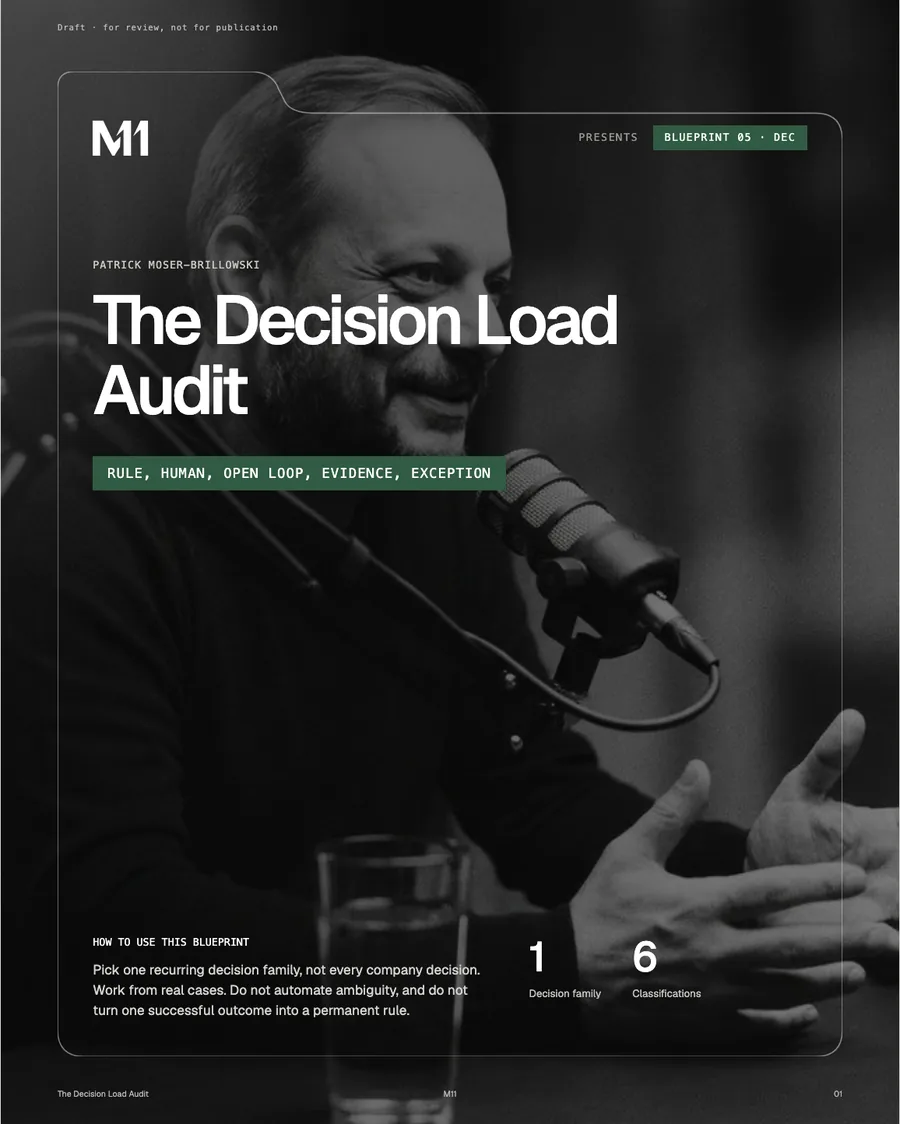
The value contract
A repeated decision should not automatically become a founder escalation, and it should not automatically become an AI decision. Decide once, reuse the decision, and keep the human part human.
How the audit runs
Decision
Which decision keeps coming back?
- How often, and who decides today
- Which cases look the same every time
Inputs
What does the decision maker actually look at?
- Evidence really used, not in theory
- What is missing when it stalls
Split
Rule, human, open loop or missing evidence?
- Where two people would decide differently
- Where judgment is genuinely required
Boundary
Who may decide what, up to which limit?
- Risk, money, customer impact
- When it must escalate
Record
How is the decision kept?
- Decision, reason, evidence, owner
- What outcome later proves it right
Classify every recurring case
Each case lands in one of these.
- Rule candidate
- Can become an explicit rule or threshold.
- Human required
- Risk, accountability, negotiation, ethics.
- Open loop
- Waiting for a person, evidence or time.
- Missing evidence
- Not a decision problem. An information problem.
- System exception
- Only exists because a system is weak.
What AI may do here
Preparation is not the same as deciding.
- Gather
- Pull the evidence the decision needs.
- Compare
- Put the options side by side with their consequences.
- Apply rules
- Run the standard cases inside the agreed limits.
- Flag
- Send the exceptions to the right person.
- Never
- Decide where accountability or risk sits with a human.
Inside the Blueprint
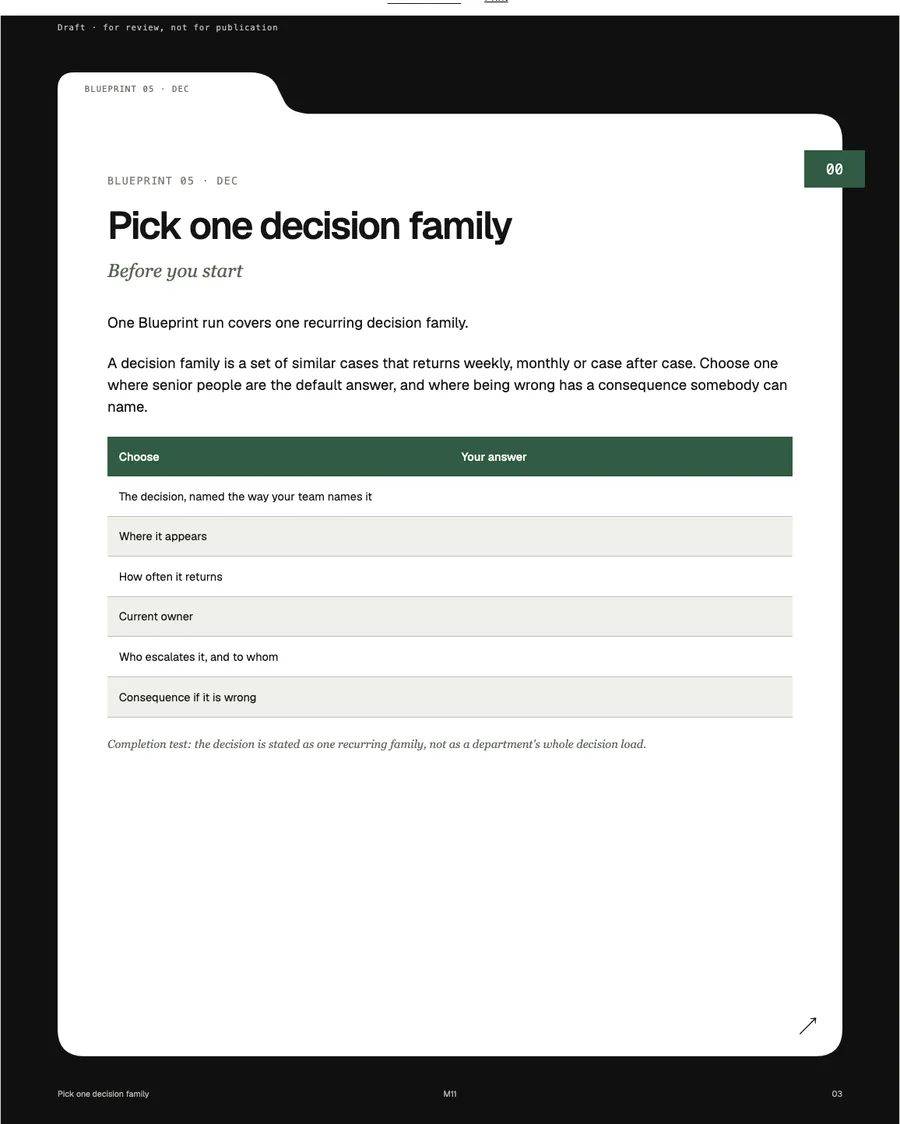
Every layer gets its own page: the question, a table you fill in for your own process, a short checklist and the transition to the next layer. Designed to be printed and written on.
- 01DecisionWhich decision keeps coming back?
- 02InputsWhat does the decision maker actually look at?
- 03SplitRule, human, open loop or missing evidence?
- 04BoundaryWho may decide what, up to which limit?
- 05RecordHow is the decision kept?
Worked example preview
Illustration: the discount request from sales.
Sales asks for an extra discount, the owner decides case by case.
Margin, customer history, competitor pressure, gut feeling.
Up to a certain margin it is a rule. Below that, or for a key account, it stays human.
Sales decides inside the limit, the owner decides beyond it, both are written down.
Every exception is logged with a reason, so the rule can be corrected later.
Illustrative example to show the format, not a client case.
What you receive
- One recurring decision, described as it actually runs
- Rule candidate, human required, open loop, missing evidence, system exception
- A rule contract for the parts that can be reused
- Clear escalation triggers for the rest
- A decision record you can review later
Get the Blueprint
Enter your email and download the Blueprint right away. The Thursday notes follow in your inbox, in German and English.
What did you find?
Your next step.
A navigator, not a funnel. Sometimes the honest answer is that no other Blueprint is needed.
The underlying work is unclear, so no stable decision contract can exist
5S AI-Ready Company Map →The burden is mainly a role, capacity or handoff problem
5R Capacity Checklist →Repeated exceptions come from a missing or weak capability
Company Systems Map →The decision stalls because evidence or context is missing or inaccessible
Context Readiness Map →The decision is material and future facing
90-Day Scenario Map →The decision is legitimately human: accountability, negotiation, ethics, risk
In your language
Need it in German, French or Italian?
The Blueprint is written in English. Open the PDF in ChatGPT or Claude and paste this prompt. Change the language in the first line.
Translate this Blueprint into German (Switzerland). Keep the structure, every table, every checklist and every question. Keep method names such as Strategy, SOP, Skill, System and Session in English. Use plain, calm business language, address the reader informally, and do not add or remove any content.
Related writing