Home Blueprints MAP
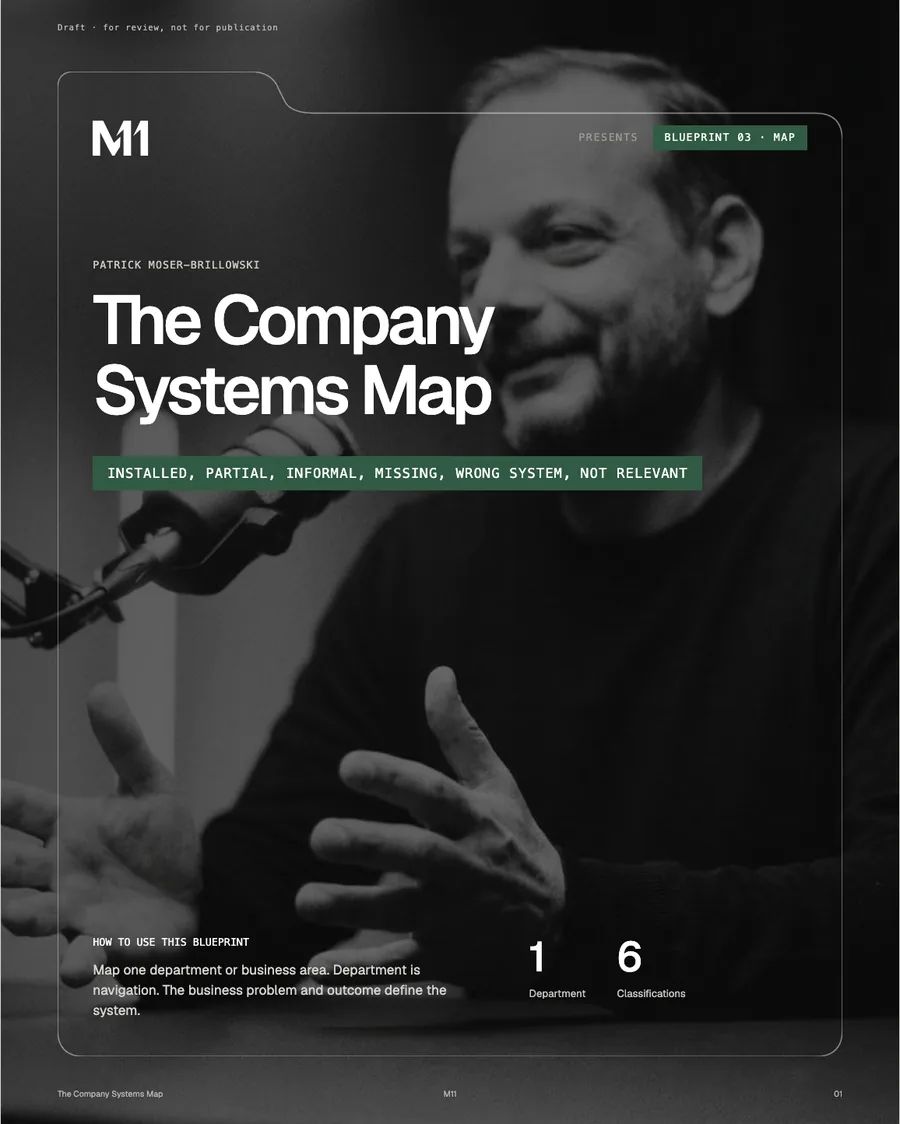
MAP The Company Systems Map
Map one department. See what is installed, what is informal, what is missing.
You have SOPs, tools and a lot of recurring work, but no clear view of the small operating systems that already exist, run informally, or are missing.
Get the Blueprint.
The value contract
Not a software audit. A map of the mechanisms that actually run a department, so the next thing you build is the one that unblocks the most work.
How the map is built
Problems
Which recurring problems cost attention, time, money or customer trust?
- What the department is accountable for
- Where delay and friction appear
Candidates
Which operating systems could serve those problems?
- Named mechanisms, not tools
- Only what this department really needs
Status
What is the honest state of each one?
- Installed, partial, informal, missing
- Wrong system, or not relevant here
Evidence
What proves the status?
- Documents, data, meetings, behaviour
- Who owns it today
Next
Which capability is worth building next?
- Dependencies and blockers
- And what not to build
Status per system
Every relevant system gets one honest label.
- Installed
- Named, owned and running.
- Partial
- Exists, but rules, owner or inputs are unresolved.
- Informal
- Works only because experienced people hold it together.
- Missing
- Needed here and does not exist.
- Wrong system
- Solves the wrong problem or creates side effects.
- Not relevant
- Legitimately unnecessary in this company.
Where a problem really belongs
Not every gap is a missing system.
- Goes to 5S
- The work itself is not described well enough.
- Goes to 5R
- The issue is role and capacity, not a mechanism.
- Goes to Context
- People keep re-explaining the same company facts.
- Goes to Decisions
- The same decision is escalated again and again.
Inside the Blueprint
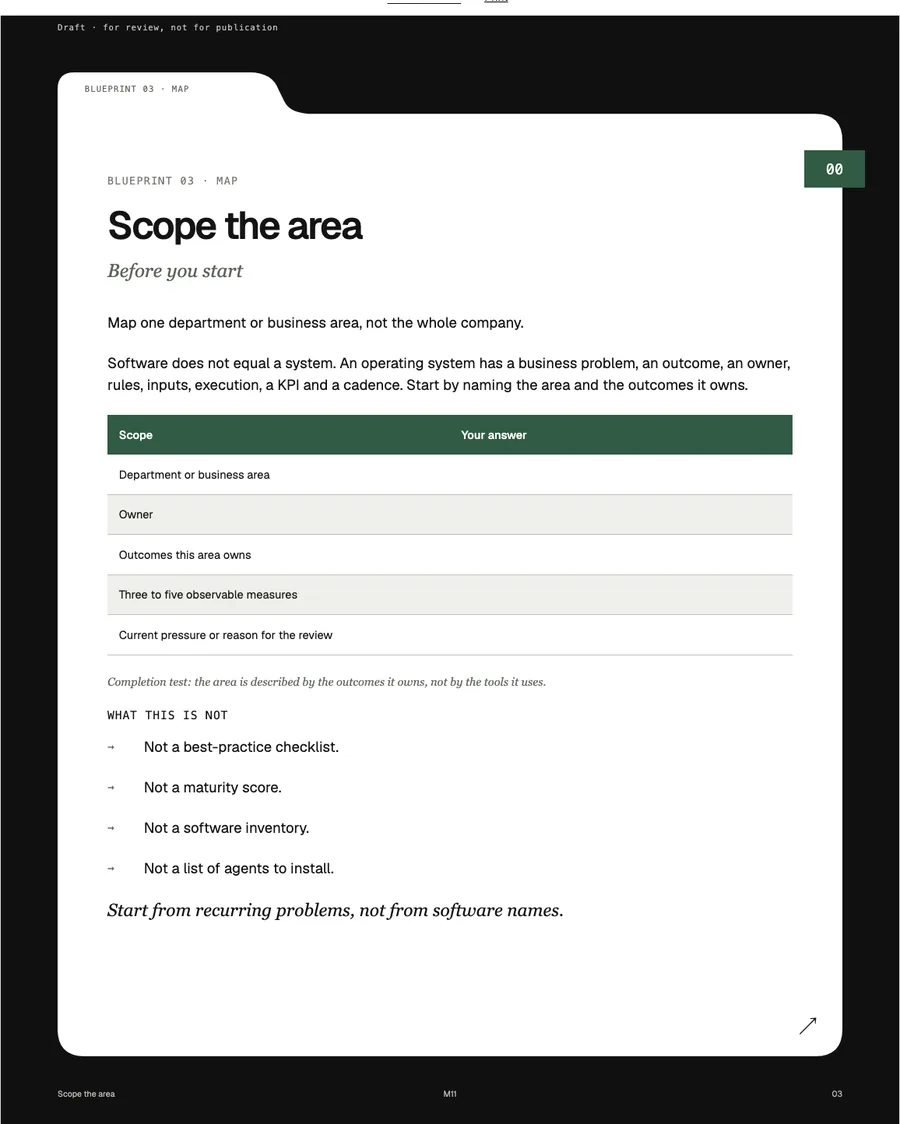
Every layer gets its own page: the question, a table you fill in for your own process, a short checklist and the transition to the next layer. Designed to be printed and written on.
- 01ProblemsWhich recurring problems cost attention, time, money or customer trust?
- 02CandidatesWhich operating systems could serve those problems?
- 03StatusWhat is the honest state of each one?
- 04EvidenceWhat proves the status?
- 05NextWhich capability is worth building next?
Worked example preview
Illustration: purchasing in a mid-sized company.
Items run out while others sit in stock, and every reorder is discussed.
Supplier ordering and goods receipt, both named and owned.
Demand forecast lives in one buyer’s spreadsheet and memory.
Out-of-stock prevention: nobody is alerted before an item runs dry.
Build the alert before buying any AI tool. It unblocks forecast, reorder and service.
Illustrative example to show the format, not a client case.
What you receive
- A map of one department by real business problems
- Installed, partial, informal, missing, wrong system, not relevant
- Evidence and owner per system
- An explicit Do Not Build list
- The one to three capabilities worth investigating next
Get the Blueprint
Enter your email and download the Blueprint right away. The Thursday notes follow in your inbox, in German and English.
What did you find?
Your next step.
A navigator, not a funnel. Sometimes the honest answer is that no other Blueprint is needed.
The capability exists but the work or runtime is not clear enough to implement
5S AI-Ready Company Map →The system runs, but execution contains avoidable manual work
5R Capacity Checklist →The system depends on context or data that is missing, stale or contradictory
Context Readiness Map →The same judgment is sent to senior people again and again
Decision Load Audit →Building this capability has consequences across the company
90-Day Scenario Map →The candidate system is not relevant or already good enough
In your language
Need it in German, French or Italian?
The Blueprint is written in English. Open the PDF in ChatGPT or Claude and paste this prompt. Change the language in the first line.
Translate this Blueprint into German (Switzerland). Keep the structure, every table, every checklist and every question. Keep method names such as Strategy, SOP, Skill, System and Session in English. Use plain, calm business language, address the reader informally, and do not add or remove any content.
Related writing