Home Blueprints 90D
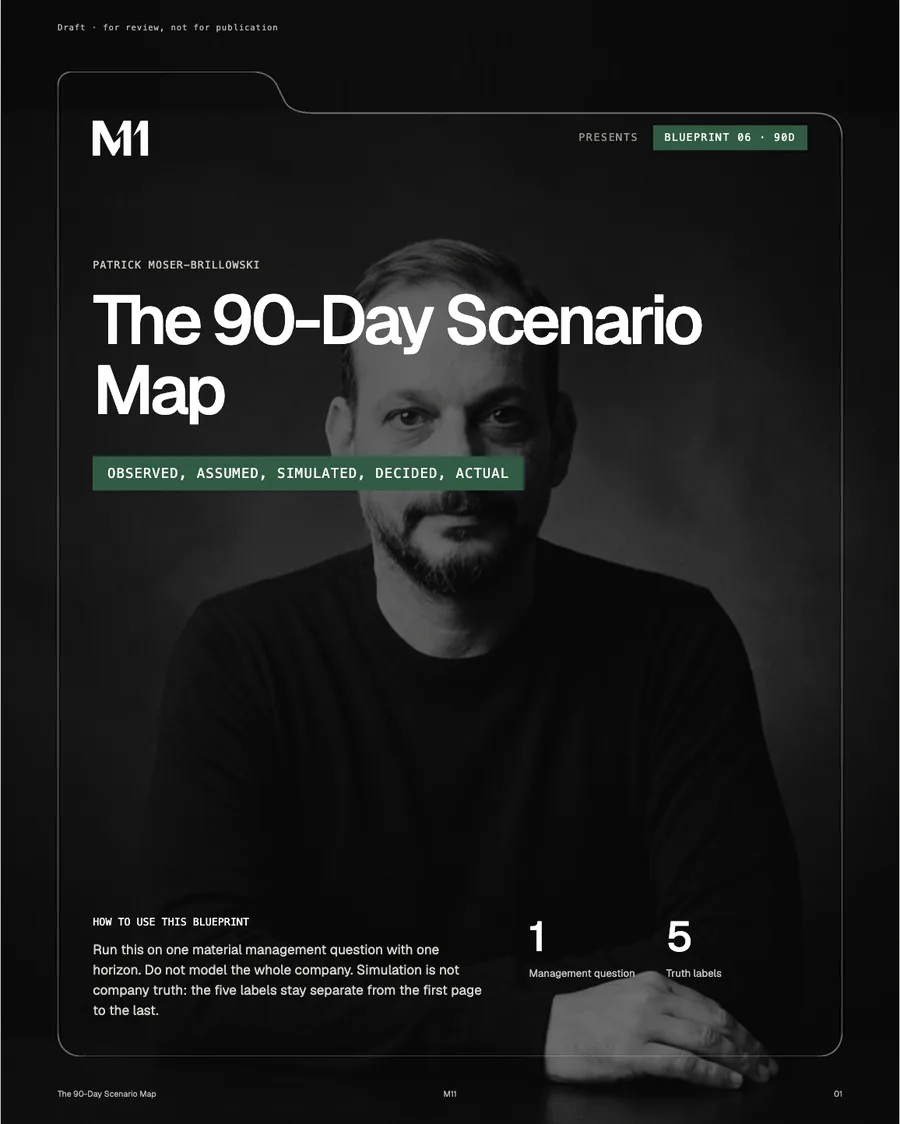
90D The 90-Day Scenario Map
Take one management question. Compare doing nothing with two or three scenarios.
Growth targets, price changes, a new hire or a supplier switch get approved without anyone seeing the second-order effects across the company.
Get the Blueprint.
The value contract
A simulation is a hypothesis, never company truth. This keeps observed facts, assumptions, simulated effects, the decision and later reality strictly apart.
How the scenario runs
Question
Which decision are we actually exploring?
- The horizon: next 90 days
- What counts as a good outcome
Observed
What is true today, with a source?
- Numbers, capacity, commitments
- What is already stale
Assumed
What must we assume to run it?
- Controllable versus external
- Who owns each assumption
Scenarios
Do nothing, and what else?
- Two or three branches, no more
- Direct and second-order effects
Check
What do we compare later?
- Predicted, decided, actual
- The date we look again
Five labels that must stay apart
Mixing these is how simulations become false certainty.
- Observed
- Measured, with source and date.
- Assumed
- Taken as given so the model can run.
- Simulated
- Follows from the assumptions. A hypothesis.
- Decided
- What management actually chose.
- Actual
- What happened. Checked later against the prediction.
What the scenario looks at
Effects rarely stay in one department.
- Cash
- Timing of money in and out.
- Stock
- Coverage, shortage, capital tied up.
- Workload
- Which roles absorb the change.
- Service
- Delivery time, quality, complaints.
- Reversibility
- What can be undone, and what cannot.
Inside the Blueprint
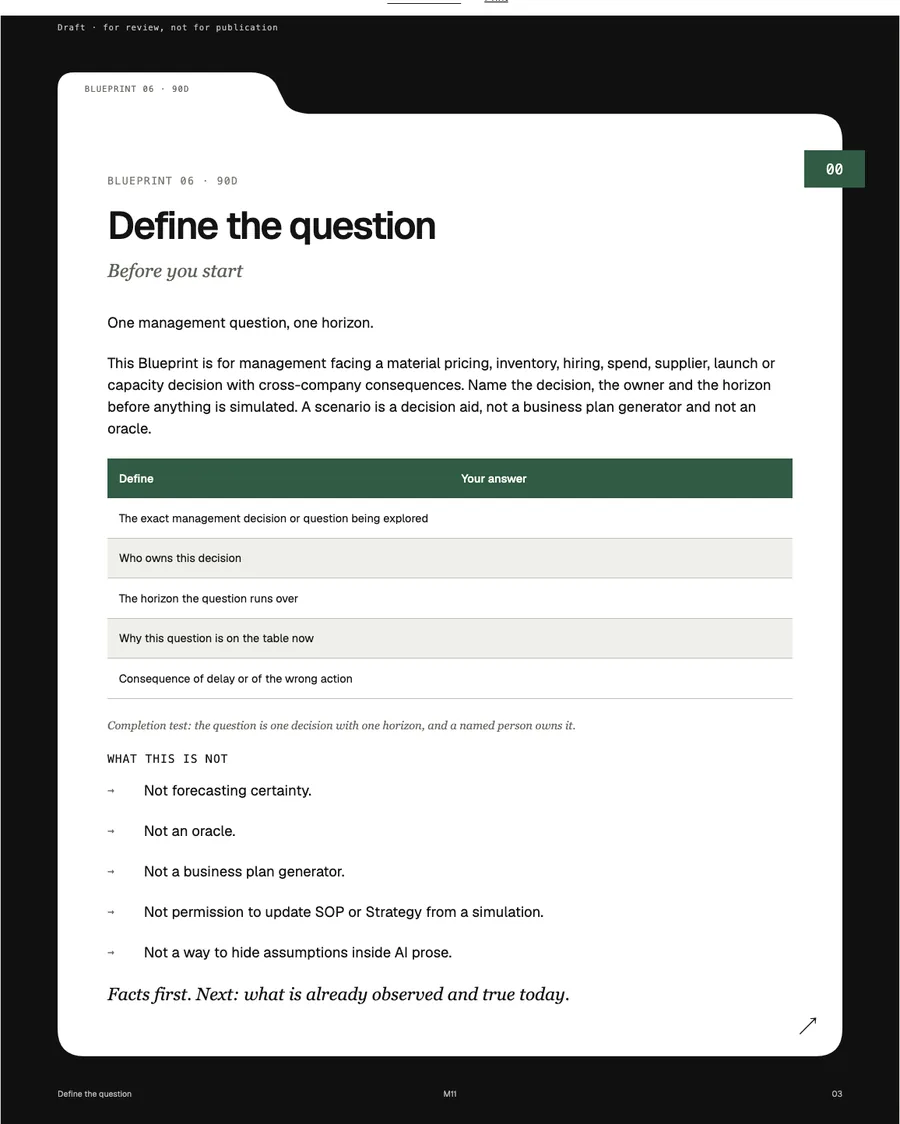
Every layer gets its own page: the question, a table you fill in for your own process, a short checklist and the transition to the next layer. Designed to be printed and written on.
- 01QuestionWhich decision are we actually exploring?
- 02ObservedWhat is true today, with a source?
- 03AssumedWhat must we assume to run it?
- 04ScenariosDo nothing, and what else?
- 05CheckWhat do we compare later?
Worked example preview
Illustration: seasonal stock before a strong quarter.
Should we buy extra stock for the season, and how much?
Current coverage, supplier lead times, last season’s sell-through.
Demand up by a set percentage, no supplier delay. Both owned and labelled.
Do nothing, buy half, buy full. Cash, storage and service compared.
Review after 90 days: what was predicted, what was decided, what happened.
Illustrative example to show the format, not a client case. No invented numbers.
What you receive
- One management question, framed as a decision
- Observed facts with sources, assumptions with owners
- A do-nothing base case plus up to three branches
- Direct and second-order effects across departments
- Reversible versus hard to reverse, and a review date
Simulation is a hypothesis, not company truth. Nothing here is written back as fact.
Get the Blueprint
Enter your email and download the Blueprint right away. The Thursday notes follow in your inbox, in German and English.
What did you find?
Your next step.
A navigator, not a funnel. Sometimes the honest answer is that no other Blueprint is needed.
The scenario cannot be built because the underlying process is unclear
5S AI-Ready Company Map →The scenario depends on an operating system that does not exist yet
Company Systems Map →The constraint is a role and its capacity, not the decision itself
5R Capacity Checklist →The same management question keeps returning without a rule
Decision Load Audit →The inputs are scattered, stale or re-explained before every run
Context Readiness Map →Observed, assumed, simulated, decided and actual stay separate
In your language
Need it in German, French or Italian?
The Blueprint is written in English. Open the PDF in ChatGPT or Claude and paste this prompt. Change the language in the first line.
Translate this Blueprint into German (Switzerland). Keep the structure, every table, every checklist and every question. Keep method names such as Strategy, SOP, Skill, System and Session in English. Use plain, calm business language, address the reader informally, and do not add or remove any content.
Related writing