Home Blueprints CTX
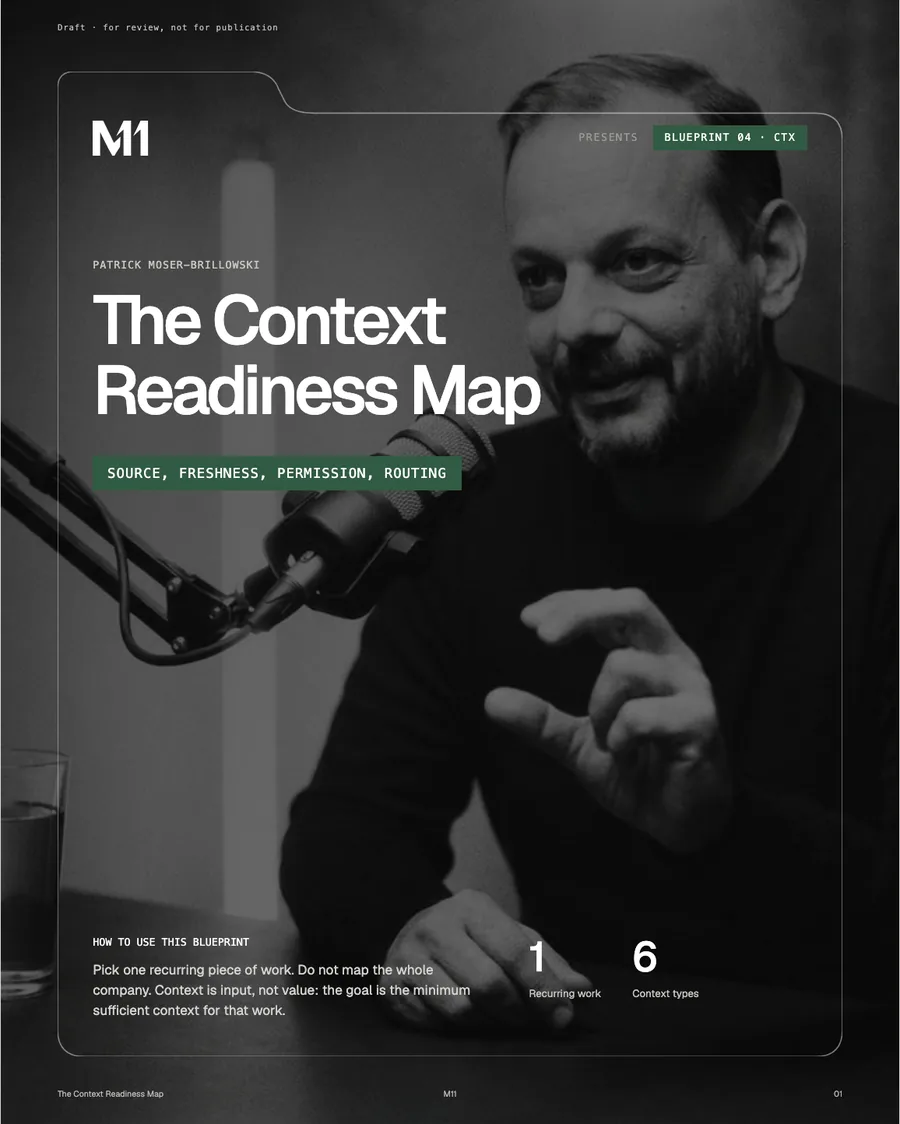
CTX The Context Readiness Map
Take one recurring task. Find the context it needs, and where that context really lives.
Every serious AI conversation starts with someone explaining the company again, while the important context sits in people, files, systems and old decisions.
Get the Blueprint.
The value contract
A company does not need more context everywhere. It needs reusable context objects with a source, an owner, a freshness rule and a permission boundary, so the work gets the minimum sufficient context.
How the audit runs
Work
Which recurring piece of work are we looking at?
- Who or what consumes the context
- What gets explained again every time
Objects
Which pieces of context does it need?
- Rules, facts, current state, past decisions
- What people search for before starting
Source
Where does the truth live for each one?
- Canonical source and owner
- Duplicates and contradictions
Freshness
How long does it stay true?
- What goes stale in days
- What is permission sensitive
Routing
What happens with it at runtime?
- Always load, load on condition, fetch
- Ask a human, or exclude
Types of context
Different types need different handling.
- Stable method
- How the company works. Changes rarely.
- Company fact
- True about this company, until someone changes it.
- Current state
- Today’s numbers, stock, pipeline, status.
- Historical decision
- Was decided once. History, not current truth.
- Assumption
- Believed, not verified. Must stay labelled.
- Runtime observation
- Appears while the work runs.
Routing per object
What the system does with each piece.
- Always load
- Needed on every run.
- Conditional
- Only for certain cases or departments.
- Fetch at runtime
- Pulled fresh when the work starts.
- Human clarification
- Evidence is missing. A person decides.
- Exclude
- Sensitive or misleading. Stays out.
Inside the Blueprint
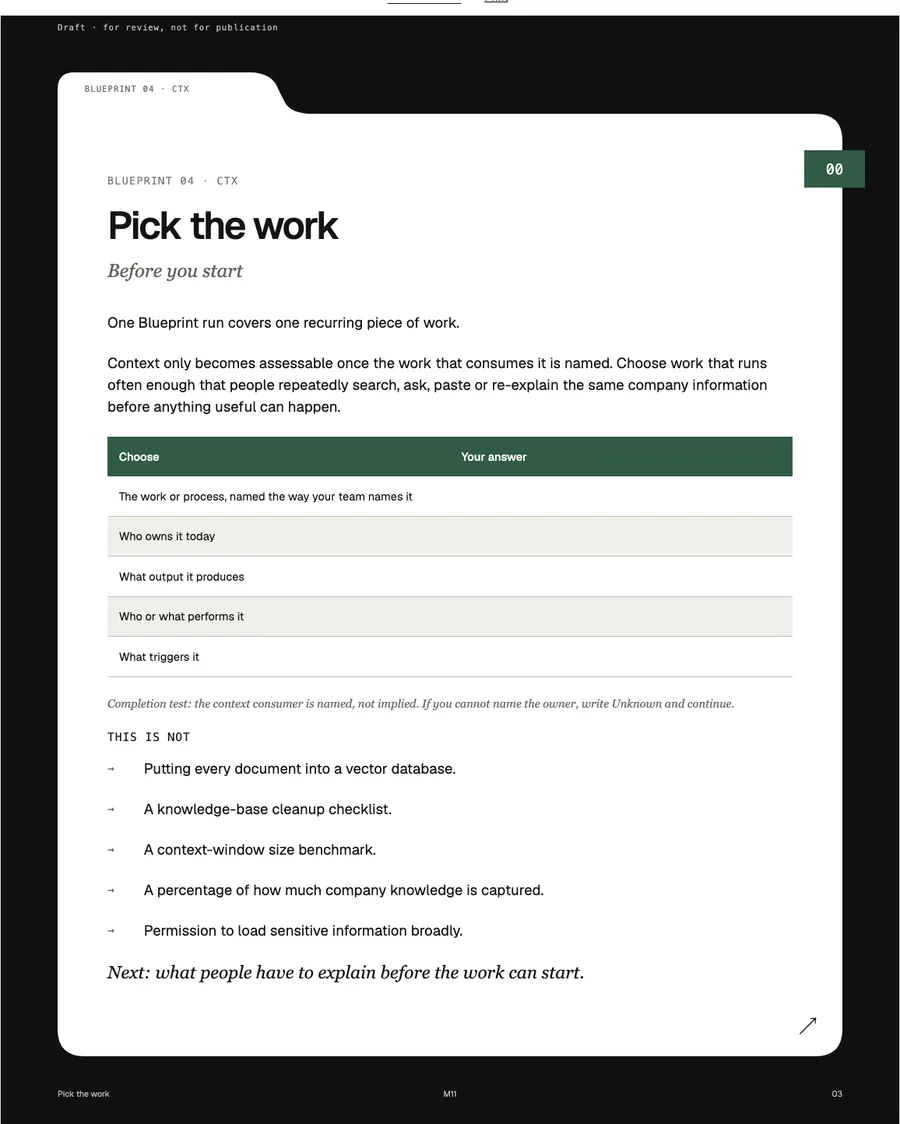
Every layer gets its own page: the question, a table you fill in for your own process, a short checklist and the transition to the next layer. Designed to be printed and written on.
- 01WorkWhich recurring piece of work are we looking at?
- 02ObjectsWhich pieces of context does it need?
- 03SourceWhere does the truth live for each one?
- 04FreshnessHow long does it stay true?
- 05RoutingWhat happens with it at runtime?
Worked example preview
Illustration: answering a customer complaint.
A complaint arrives and someone has to answer it properly.
Warranty rules, this customer’s history, current delivery status, past goodwill decisions.
Rules in a PDF nobody opens, history in the ERP, goodwill only in the owner’s head.
Delivery status is stale after a day. Warranty rules change once a year.
Rules always load, history is fetched, goodwill limits become a rule, prices stay excluded.
Illustrative example to show the format, not a client case.
What you receive
- The context one recurring task needs, listed
- Canonical source and owner per object
- Freshness rules and permission boundaries
- Contradictions and duplicates made visible
- Always load, conditional, fetch, ask a human or exclude
Get the Blueprint
Enter your email and download the Blueprint right away. The Thursday notes follow in your inbox, in German and English.
What did you find?
Your next step.
A navigator, not a funnel. Sometimes the honest answer is that no other Blueprint is needed.
The work itself cannot be described clearly enough to say what context it needs
5S AI-Ready Company Map →The missing context exists only because a capability was never built
Company Systems Map →The re-explaining happens around a role, not around the task
5R Capacity Checklist →The same judgment is re-made because the reasoning was never recorded
Decision Load Audit →The context is needed to model a decision that has not been taken yet
90-Day Scenario Map →Every context object has a source, a freshness rule and a permission
In your language
Need it in German, French or Italian?
The Blueprint is written in English. Open the PDF in ChatGPT or Claude and paste this prompt. Change the language in the first line.
Translate this Blueprint into German (Switzerland). Keep the structure, every table, every checklist and every question. Keep method names such as Strategy, SOP, Skill, System and Session in English. Use plain, calm business language, address the reader informally, and do not add or remove any content.
Related writing