Home Blueprints 5R
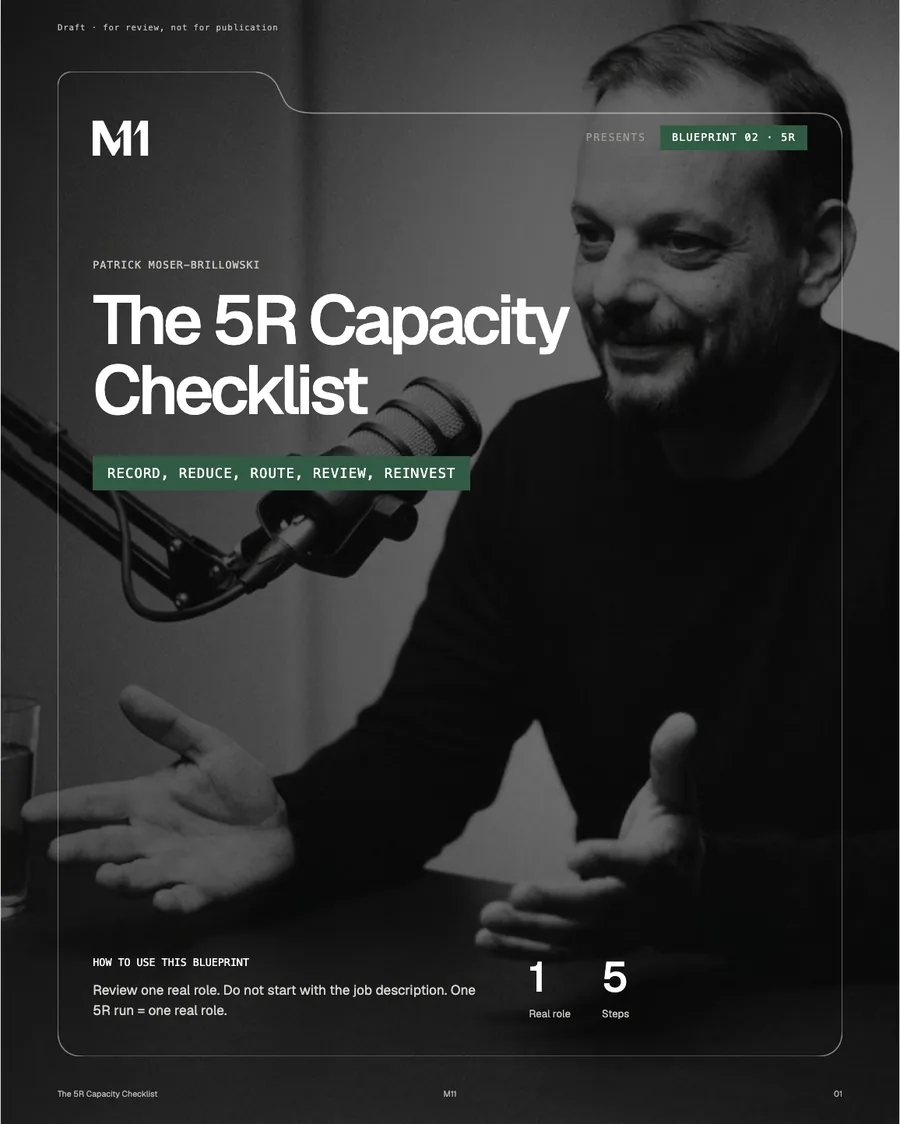
5R The Capacity Checklist
Pick one role. List the work. Find the capacity.
You are about to hire, replace or keep a role without knowing which of its work still needs a human.
Get the Blueprint.
The value contract
Start from the real work, not the job description. Decompose one role before you hire, replace or automate anything, and end with an explicit owner decision.
The 5R loop
Record
Capture the real recurring work, including invisible coordination and exception work.
Reduce
Delete or simplify work before automating anything.
Route
Sort what remains into Human Core, AI Prepare, AI Execute and Build First.
Review
Check quality, errors, speed, human review, exceptions, and whether the output changed the work that follows.
Reinvest
The owner decides: Role Smaller, Employee Bigger, or No Role Change.
Human Core vs AI work
Every recurring activity of the role ends up in one of four groups.
- Human Core
- Negotiation, empathy, accountability, creativity, risk ownership.
- AI Prepare
- AI prepares, a person approves.
- AI Execute
- AI runs it inside clear boundaries.
- Build First
- Needs rules, context, a skill or system access before AI can help.
The six company levers
Where the capacity usually comes from.
- Shared Skill
- Teach once, use everywhere.
- Shared Rules
- Decide once, reuse the decision.
- Shared Context
- Explain the company once, not every time.
- Direct Access
- Stop moving work between systems by hand.
- Autonomous Run
- Let recurring work start on its own.
- Exception Routing
- Humans handle what deserves a human.
Inside the Blueprint
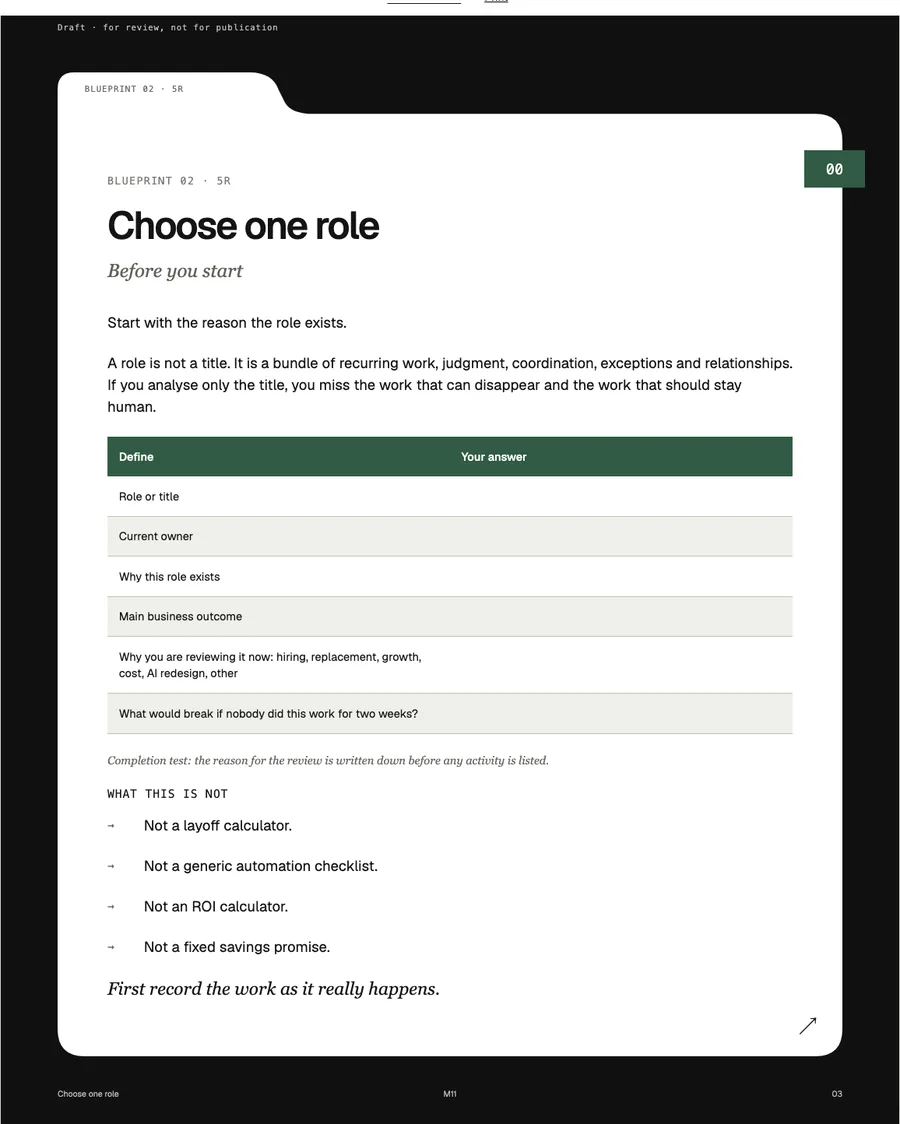
Every layer gets its own page: the question, a table you fill in for your own process, a short checklist and the transition to the next layer. Designed to be printed and written on.
- 01RecordCapture the real recurring work, including invisible coordination and exception work.
- 02ReduceDelete or simplify work before automating anything.
- 03RouteSort what remains into Human Core, AI Prepare, AI Execute and Build First.
- 04ReviewCheck quality, errors, speed, human review, exceptions, and whether the output changed the work that follows.
- 05ReinvestThe owner decides: Role Smaller, Employee Bigger, or No Role Change.
Example: the secretary
The title looks administrative. The real job is often a routing hub between the owner, accounting, marketing, production, sales and every outside request.
List what actually arrives: calls, mails, invoices, briefs, urgent questions, and who each one is passed to.
Remove duplicate status requests and forwarding that exists only because nobody else can see the information.
Most routing follows the same unwritten rules: Build First as Shared Rules. Callers who need care stay Human Core.
Do requests reach the right person, and what happens with the ones that fit no rule?
The owner decides whether the role gets smaller or the person gets bigger, for example more customer work.
Illustrative example to show the format, not a client case. No percentages on purpose.
What you receive
- A work map of one role by real recurring activity
- What to delete or simplify first
- Human Core, AI Prepare, AI Execute and Build First
- Which of the six levers apply
- Estimated capacity, kept separate from validated value
- The owner decision: Role Smaller, Employee Bigger or No Role Change
Estimated capacity is not validated business value. Saved hours only count once they change work, action or outcome.
Get the Blueprint
Enter your email and download the Blueprint right away. The Thursday notes follow in your inbox, in German and English.
What did you find?
Your next step.
A navigator, not a funnel. Sometimes the honest answer is that no other Blueprint is needed.
The work cannot be described clearly enough to decompose
5S AI-Ready Company Map →The work exists because a reusable capability is missing or informal
Company Systems Map →Approvals, escalations and judgment loops create the workload
Decision Load Audit →Search, repeated briefing, missing access or stale knowledge create the workload
Context Readiness Map →A hiring or restructuring decision has uncertain second-order effects
90-Day Scenario Map →The role is clear and one change can be tested now
In your language
Need it in German, French or Italian?
The Blueprint is written in English. Open the PDF in ChatGPT or Claude and paste this prompt. Change the language in the first line.
Translate this Blueprint into German (Switzerland). Keep the structure, every table, every checklist and every question. Keep method names such as Strategy, SOP, Skill, System and Session in English. Use plain, calm business language, address the reader informally, and do not add or remove any content.
Related writing